We had our final lab meeting of the academic year on May 13th, and I shared our highlights, which I am restating here. Proud of the work this lab has done! My PhD advisor told me that to be successful as a professor, you must have a pipeline: grant proposals submitted, grants funded and research underway, some papers in production, some submitted and under review, some in revision, and so on. After 5 years (as of May 17!), it finally feels like we’ve got that pipeline established and flowing 🙂
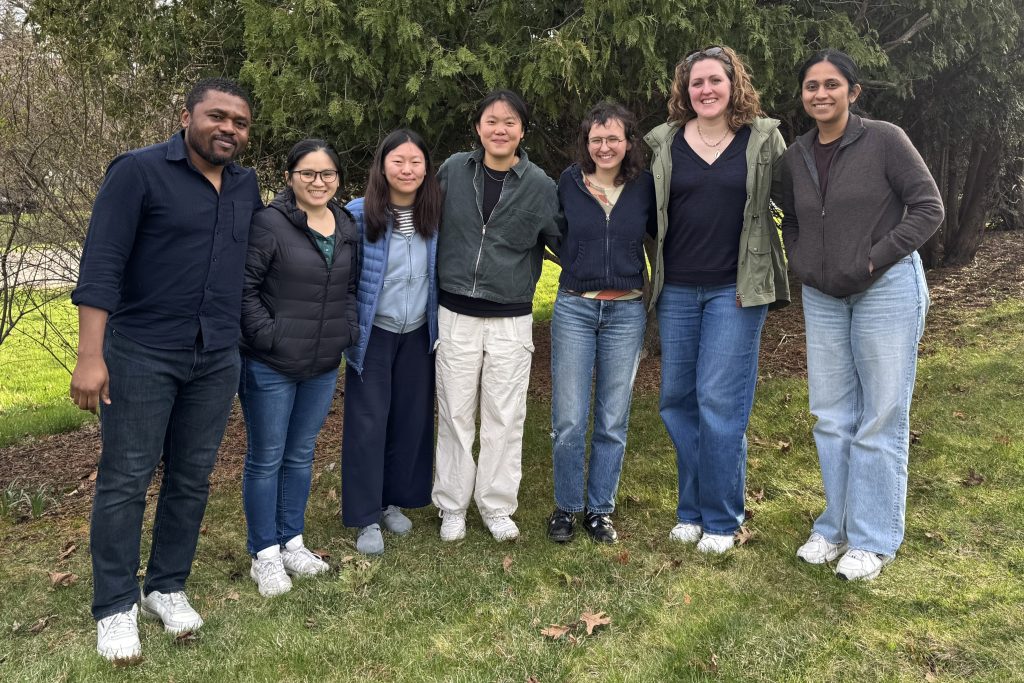
Personnel highlights
- Tayana graduated with her MS in August 2025 and is now a Jr. Process Technologist/Engineer at Ferrero. Her MS Thesis was “Producing protein films with biobased additives as a sustainable packaging alternative”.
- Tina joined our lab as a doctoral student in September 2025
- Ting joined our lab as a postdoctoral research associate in February 2026
- Sanjana and Lily passed their doctoral prelims in Spring 2026
- Lily won 2nd place in the Protein and Co-Products Division graduate student oral competition at the AOCS annual meeting in New Orleans in May 2026
- Two of our undergraduate research assistants (Wendy Lu and Sophia Delgado) graduated with their B.S. in Food Science this May. We are excited for their next steps!
Publications
- Sawant, S., GIRARD, A.L. 2025. Complexation with ionic polysaccharides mitigates pH-dependent degradation of soy protein fibril structure and functionality. Journal of Agricultural and Food Chemistry. https://doi.org/10.1021/acs.jafc.5c07627
Summary: Protein fibrils have excellent functionality, but they are unstable above pH 2 where they are formed. In this work, we studied complexation of soy protein fibrils with gellan gum and chitosan to prevent pH-induced degradation of fibrillar structure and function. We explicitly used commercial soy protein to assess fibril formation of commercially relevant ingredients. We demonstrated that chitosan effectively preserved soy protein fibril structure and function as the fibril’s environmental pH was increased from 2 to 4 by stabilizing the fibril β-sheet structure through various non-covalent interactions. The resulting sample demonstrated excellent phase stability and gelling capacity, supporting its potential use in matrices like beverages and yogurts. Meanwhile, gellan gum and protein fibrillation exhibited a synergistic effect on resulting gelling properties at pH 7. Altogether the findings indicate that ionic polysaccharides can preserve protein fibril structure and functionality upon pH change, thus extending their application in food matrices above pH 2.
- Rugji, J., Goodman, R., Mozhedi, F.J., Baker, S., Dietrich, R., Armstrong, M.T., GIRARD, A.L., Richards, M.P., Ozturk, G. 2026. Impact of spray drying and fluidized bed drying on whey protein phospholipid concentrate: microstructural analysis, bioactivity, and functionality. Journal of Dairy Science. https://doi.org/10.3168/jds.2025-27557
Summary: This study investigated how two drying methods, spray drying (SD) and fluidized bed drying (FBD), affect whey protein phospholipid concentrate (WPPC), a valuable dairy coproduct rich in bioactive compounds. Our lab’s contribution focused on protein analysis, including protein oxidation.
- Momen, S., Sawant, S., Lincoln, L., Fallen, B.D., GIRARD, A.L. 2026. Impact of soybean genotype diversity on the structure and gelation properties of soy proteins. Food Chemistry: Molecular Sciences. https://doi.org/10.1016/j.fochms.2026.100388
Summary: This work built off our previous work (Momen et al., 2025) by systematically comparing the structure and gelation behavior of soy protein isolates from 20 diverse soybean genotypes. We found that soy genetics had a significant effect on gelling properties. Extracted protein isolates that had balanced protein ratios (i.e., 11S/7S ratios) and moderate unfolding capability formed strong, elastic gels with high water retention. Glycinin-dominant genotypes, while capable of producing firm gels, tended toward rigidity and lower extensibility. Our findings provide a framework for selecting or breeding soy lines with improved functional traits for texture-focused, plant-based food formulations. Further, these fundamental findings could be used to selectively isolate proteins from currently available soy protein for desired functionality.
- Sawant, S., GIRARD, A.L. 2026. Review: Fibril synthesis from food processing by-products and strategies for structure-function stabilization for food applications. Sustainable Food Proteins. https://doi.org/10.1002/sfp2.70065
Summary: Protein fibrillation is a strategy to enhance the functional properties of proteins, especially plant proteins. The particular structure of fibrils can impart superior textural, stabilizing, and encapsulating functionalities. This review paper summarizes emerging strategies, primarily published within the last 5 years, designed to make protein fibrils more viable across both food and non-food applications such as bioplastics. Special emphasis was placed on methods to improve the sustainability of fibrils, such as through use of by-product streams for protein sources. In combination with the studies covered in this review, we synthesized arguments to extend the relevance of fibrils beyond the laboratory, establishing them as a versatile, tunable, scalable, and sustainable technology with potential applications across both food and non-food systems.
- Roark, T., Momen, S., Lincoln, L., Minkoff, B.B., GIRARD, A.L. 2026. Polyphenol-plasticized wheat gluten films via formic acid solubilization: toward compostable packaging applications. Food Chemistry. https://doi.org/10.1016/j.foodchem.2026.149438
Summary: In this work, we combined our previous findings to solubilize wheat gluten proteins in formic acid, plasticize gluten with polyphenol and low levels of glycerol, and form cohesive films that could function within food packaging. To our knowledge, this is the first instance of formic acid being used to create gluten films, and the first instance of polyphenols being used to modify structures in formic acid-solubilized protein films. Specifically, we assessed (1) whether polyphenols can partially substitute glycerol in plasticizing gluten films, thereby reducing glycerol content, and (2) how polyphenol polymerization affects film mechanical, barrier, hydration, solubility, and protein–polyphenol interaction properties.
- Budin, V., Vander Pas, M., GIRARD, A.L. 2026. Effects of polyphenols on dairy protein techno-functional properties and application in reduced-fat cream systems. ACS – Food Science & Technology. https://doi.org/10.1021/acsfoodscitech.6c00151
Summary: We demonstrated that polyphenols in the form of green tea and grape seed extracts (GTE and GSE, respectively) can enhance foaming properties of reduced-fat creams by increasing overrun and reducing drainage, likely through interactions with proteins and lipids. We studied the effects of GTE and GSE on dairy protein fractions (milk protein isolate, micellar caseins, and whey protein isolate) techno-functional properties (foaming, emulsifying, and gelling). We then created reduced fat creams (from a high of 36% to a low of 25% lipids) by diluting them with skim milk and assessed how GTE and GSE altered the foaming properties of these reduced fat creams, including rheological analysis. One of the coolest parts of this work is that the students on it, Tori and Macy, did most of the work as undergraduates!